

Macallum Tepsich
2026-05-29
Why Davisville Village Keeps Winning: The Case for Midtown Toronto Freehold
A data-backed look at the neighbourhood that move-up buyers keep choosing — and why the fundamentals only get stronger from here.
Why Davisville Village Keeps Winning: The Case for Midtown Toronto Freehold
A data-backed look at the neighbourhood that move-up buyers keep choosing — and why the fundamentals only get stronger from here.
$1.8M Average freehold (detached, semi, townhouse) sale price, Davisville Village (2025)
97/100 Walk Score — one of the highest in Toronto
9.2/10 Fraser Institute rating for North Toronto Collegiate Institute
THE STORY
Every week someone asks whether Davisville Village has finally peaked. Whether the price premium over comparable Midtown neighbourhoods is justified. Whether buyers are paying for the name more than the fundamentals.
The answer, every time, is the same: the fundamentals are the name.
Davisville Village sits at a rare convergence — walkable streets, green space, a transit network that just became meaningfully stronger, and a school catchment that families will pay a meaningful premium to access. These aren't soft amenities. They're structural advantages that compound over time, and they're exactly why move-up buyers who could live anywhere in Midtown keep landing here.
Here's how the case breaks down.
WALKABILITY: THE REAL KIND
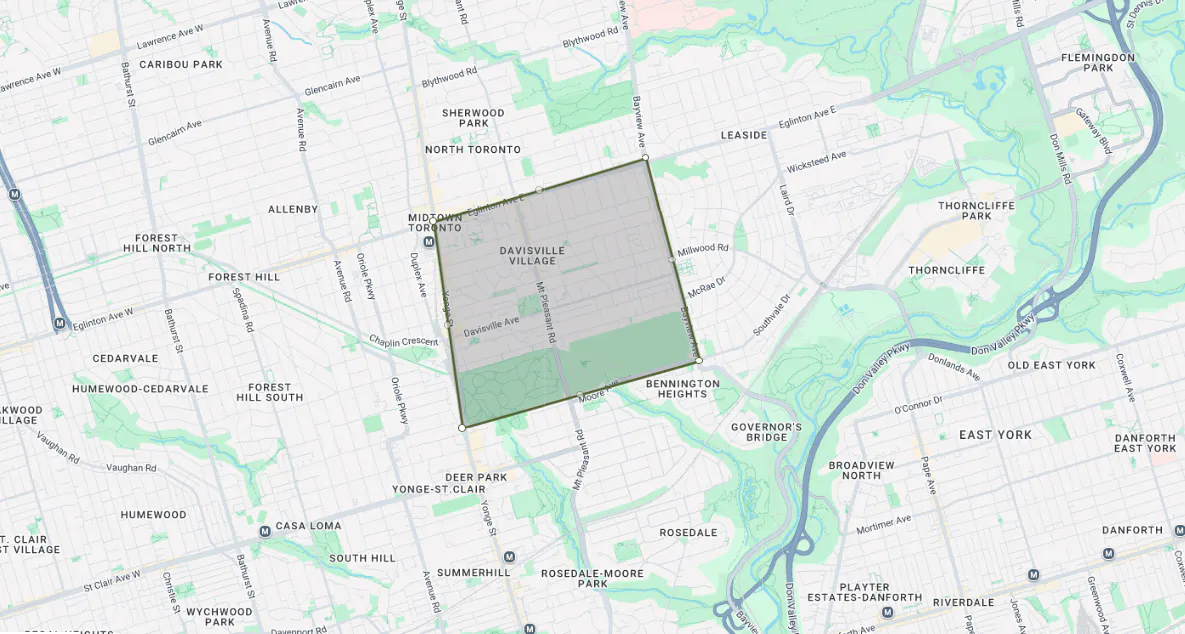
Davisville Village carries a Walk Score of 97 out of 100 — not the kind of number that comes from being near a single grocery store, but the kind that reflects genuine urban infrastructure. Yonge Street runs through the core of the neighbourhood, lined with independent restaurants, coffee shops, pharmacies, and specialty food stores. Mount Pleasant Road adds another retail corridor to the east. Bayview Avenue anchors the neighbourhood's quieter, more residential eastern edge.
What makes the walkability feel different here is the mix. You can get your dry cleaning done, have a proper dinner, pick up wine, and stop at the library without getting in a car. That's not the experience in every neighbourhood that scores well on paper.
The Kay Gardner Beltline Trail — a converted 19th-century rail corridor that runs directly through the neighbourhood — adds a dimension that walkability scores don't fully capture. It's a 9-kilometre linear park threading through mature trees, connecting Davisville to Forest Hill, Moore Park, and beyond. Families use it daily. Runners, cyclists, and dog owners have made it part of their routine in a way that creates genuine community cohesion. It's the kind of amenity that doesn't show up on a listing sheet but absolutely shows up in buyer demand.
TRANSIT: THE CROSSTOWN CHANGES THE MATH
For the past decade, Davisville Village's transit story was built around Line 1 — the Yonge-University subway, with Davisville station sitting at the neighbourhood's heart. That's already a strong foundation. A 25-minute subway ride to Union Station. Reliable, frequent, and one of the city's highest-ridership corridors.
Then, on February 8, 2026, the Eglinton Crosstown LRT officially opened.
The Crosstown — now operating as Line 5 Eglinton — runs 19 kilometres across Midtown Toronto, connecting Kennedy Station in the east to Mount Dennis in the west. It links to three TTC subway stations (including Eglinton, minutes from Davisville), 68 bus routes, two GO lines, and the UP Express. More than 10 kilometres of the line runs underground.
For Davisville residents, what this creates is a genuine transit hub at Yonge and Eglinton — two-directional rapid transit connecting the neighbourhood east-west and north-south. Getting to the financial district, to Pearson, to Scarborough, or to Mississauga is now materially faster than it was a year ago. For dual-income households commuting to different parts of the city, that's not a minor upgrade. It's a quality-of-life shift.
And transit infrastructure, once built, tends to anchor property values over time. The Crosstown has been priced in speculatively for years. Now it's real.
SCHOOLS: THE FLOOR UNDER THE FLOOR
In Toronto real estate, school catchments don't just influence buyer behaviour — they create price floors. Families will trade square footage, renovation quality, and even transit access before they'll compromise on secondary school catchment once that becomes a priority.
Davisville Village sits in the catchment for North Toronto Collegiate Institute (NTCI). It's consistently ranked among the best public secondary schools in Toronto, with a Fraser Institute rating of 9.2 out of 10. NTCI is closed to optional attendance — meaning you can't access it from outside the catchment — which makes living within the boundary a genuine, non-replicable asset.
At the elementary level, Davisville Junior Public School and Maurice Cody Public School both serve the neighbourhood, with Maurice Cody drawing particular demand from families on the eastern side. For parents planning years ahead — buying now, with children who won't enter NTCI for another seven years — catchment access is part of the calculus from the first showing.
THE MOVE-UP BUYER THESIS
Who keeps buying in Davisville Village? The pattern is consistent. It's buyers who have already lived in Toronto, who know the city's neighbourhoods well, and who are making a considered trade-up from a condo or a first home in a less central location. They've done the comparison. They've looked at Leaside (more inventory, lower density, quieter streets), at Yonge and Eglinton proper (more condos, less freehold), at Moore Park (larger lots, less retail). And they keep landing here.
The reason is balance. Davisville Village offers the walkability of a more urban neighbourhood without the noise and density. It offers the green space and community feel of a quieter pocket without the isolation. The freehold stock — primarily detached and semi-detached homes on streets like Balliol, Merton, Hillsdale, and Belsize — gives buyers the ownership structure they want with the urban lifestyle they don't want to give up.
Detached homes averaged roughly $1.94 million in 2025, with semis tracking around $1.49 million. Volume was up year-over-year across all home types, with semi-detached sales particularly active — up more than 50% — as buyers found relative value in the segment. The top sale of the year, a four-bedroom home on Balliol Street, sold at full asking price after just four days on the market. In a year when most of the Toronto market was moving slowly, that kind of result signals real demand, not noise.
WHAT IT MEANS FOR YOU
If you're a move-up buyer considering Davisville
The structural case for this neighbourhood is as strong as it's ever been. The Crosstown adds real transit value that wasn't there before. School catchment access for NTCI is non-replicable — you either live in the boundary or you don't. And the freehold stock here, relative to what you'd pay in Rosedale or Forest Hill for comparable size and condition, still represents genuine value. Don't wait for the market to confirm what the fundamentals already show.
If you're a seller in Davisville
Well-prepared, properly priced freehold product moves. The Balliol result wasn't an anomaly — it was a demonstration that serious buyers exist and will act when the right home comes to market. Presentation and strategy matter enormously in a market where buyers are selective. Price it right the first time.
If you're watching from the sidelines
The Crosstown opening, post-correction pricing, and a supply environment where very little new freehold is entering Midtown Toronto combine into an unusual window. Davisville Village isn't a speculative play. It's a neighbourhood with proven, durable demand. The question is whether you're entering it at today's prices or at whatever comes next.
The bottom line
Davisville Village keeps winning because the things that make it desirable aren't trends. They're infrastructure, schools, and street-level quality of life — none of which is easy to replicate and none of which depreciates. Move-up buyers aren't choosing it by default. They're choosing it on purpose, after looking at everything else.
That's the most durable signal there is.
Macallum Tepsich is a Sales Representative at Chestnut Park Real Estate, advising buyers and sellers across Rosedale, Summerhill, Moore Park, Davisville Village, Leaside, and Lawrence Park.